Translation Tool

Monday, January 24, 2011

Daily DXY Roundup - 1/24


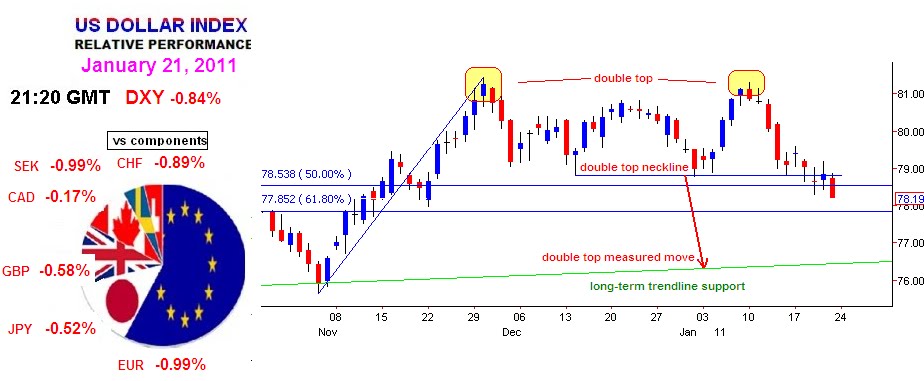
The US Dollar ended the day modestly lower after finding short-term support from a key Fibonacci retracement at 77.852. The DXY, however, is trending lower within a short-term bearish channel pattern and will need to close above the broken 50% retracement level at 78.538 to avoid weakening further. In the meantime, a clean downside break of the 61.8% retracement support will expose the long-term trendline support and double top target in the mid-76 range.


The euro pared early gains, finishing up slightly higher on the day against a trade-weighted basket of currencies. There are tentative signs that the single currency may be at least due to consolidate here. The Euro Index and EUR/JPY both marked daily doji patterns, meriting a possible correction given overbought daily conditions. The EUR/AUD and EUR/CHF each triggered daily bearish engulfment patterns. And, the EUR/USD is once again trading within a rising wedge, which requires a loss of formation support in the 1.3580 region to confirm a meaningful reversal.

Friday, January 21, 2011

Daily DXY Roundup: 1/21


The US Dollar fell across the board following a surge in global risk appetite. Solid corporate earnings by General Electric and a record high in a German confidence survey helped drag the safe-haven greenback lower, triggering a 0.84% loss on the day against a trade-weighted basket of currencies. The Dollar Index (DXY) reversed lower after briefly probing above the key 78.820 pivot, which served as former platform support and the neckline of the latest double top formation.
.
Today's bearish price-action also marks the first close below the midpoint of the November advance. The next downside target is 77.842, where the 61.8% retracement lies. If a corrective rally fails to materialize above the broken 50% retracement at 78.538, then the double top target could be in the cards. Ironically, this measured move coincides with long-term trendline support that originates from the all-time lows. Moreover, this would also equate to a retest of critical support at 22 for the Dollar Index ETF (UUP).
.
While a weekly bearish engulfment pattern was confirmed with this week's follow-through weakness, there is a glimmer of hope for dollar bulls. Often when price-action closes at the lows of the week, it is often representive of a short-term selling exhaustion. Also, the latest CFTC Commitment of Traders report demonstrated that euro speculators had flipped to a small net-long position earlier in the week. This suggests the completion of short-covering for the EUR/USD and could limit gains in the near-term.
.
Meanwhile, the highly correlated 2-year EU/US yield gap tested the November high before consolidating for the remainder of the North American session. A move above the +68 basis point differential would mark a fresh 2-year high in the EU's favor. As such, the euro should continue to outperform while european peripheral yield spreads narrow and yield differentials vs. the US continue to widen.

CHART OF THE DAY


Thursday, January 20, 2011

Daily DXY Roundup: 1/20


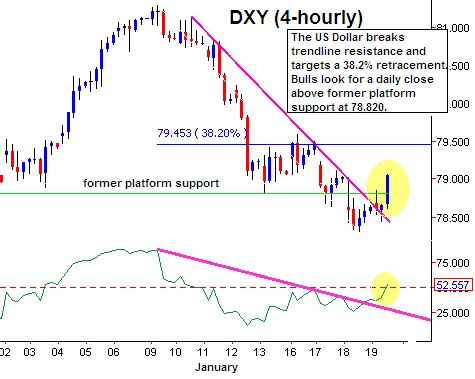
The US Dollar Index (DXY) finished the day modestly higher after giving up a bulk of earlier gains. The greenback broke above 9-day trendline resistance but failed to materially follow-through. The (9-period) 4-hourly RSI midpoint rejected strength once again, but could be breached in the following sessions given bullish intraday studies and the formation of a small-base in price-action. Moreover, the inability to close below the key 50% at 78.538 is also an encouraging sign for dollar bulls. Meanwhile, if the current corrective phase fails to reach 79.543 (the 38.2% retracement of recent weakness), then focus shifts back towards 78.538. A daily close below this important pivot could produce a selling capitulation towards long-term trendline support below the 77 handle.


The Japanese Yen was the weakest performer on the day, following a warning from a government report concerning the potential worsening debt problem for Japan. The currency fell more than 1% vs. a trade-weighted basket, as the USD/JPY broke out of a 10-day falling wedge. The pair then rallied 50 pips, settling right below a key downward sloping trendline. A break above resistance just above 83Y would expose the recent highs in the 84.34/84.51 region.

DXY UPDATE


CHART OF THE DAY


Wednesday, January 19, 2011

Daily DXY Roundup: 1/19


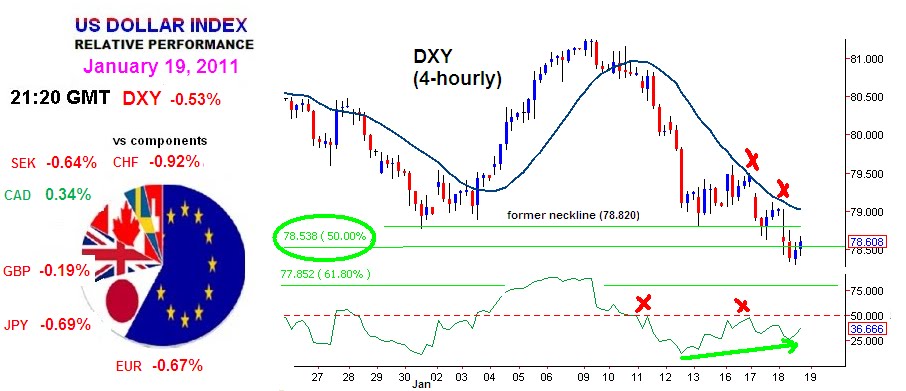
The US Dollar Index (DXY) weakened again, losing 0.53% vs. a trade-weighted basket of currencies. After failing to extend Tuesday's late-day rally, the greenback relapsed to fresh 10-week lows. Bullish intraday studies (4-hourly RSI) triggered a minor relief rally after briefly probing the key 50% retracement at 78.538. Today's price-action has set-up a one-week downward sloping trendline, providing an obvious pivot point. Dollar bulls will now look to break resistance at 78.633 and close above former platform support at 78.820 to avoid potentially capitulating through the 61.8% retracement at 77.852.

CHART OF THE DAY


Tuesday, January 18, 2011

Daily DXY Roundup: 1/18


The US Dollar Index (DXY) finished the day modestly lower after recovering from a fresh 7-week low. Bullish intraday studies (4-hourly) managed to trigger a rebound, possibly marking a false-break of former platform support. While a 6-week double top was confirmed, the rebound back above the formation neckline at 78.820 negates weakness. The 4-hour RSI and 18-period moving average hold the key for a sustained recovery, especially since both metrics capped price-action recently. Also lending support for dollar bulls is the completion of a 5-wave structure off the January high. This suggests a potential re-test of Monday's low, which is located just below the 38.2% retracement of the January 10th/18th relapse. Meanwhile, if the greenback fails to clear the 18-period (4-hourly) moving average, then the next downside target lies between 77.853/78.535, the 61.8% & 50% retracement levels of the entire late-October to December advance.

The Canadian Dollar was the weakest performing major currency, following the Bank of Canada's decision to keep interest rates unchanged. The loonie fell 0.61% vs. a trade-weighted basket of currencies, as expectations for a rate hike were pushed back further. Since reaching a fresh 2 1/2-year high, the Canadian exchange-rate index has formed a head & shoulders pattern. While recent price-action has closed below the neckline, follow-through weakness is required to confirm this bearish formation. If confirmed, however, then the GBP/CAD should re-test the 1.60 region. Either way, tomorrow's price-action will probably dictate direction for the rest of the week.

An Introduction to Technical Analysis


To request a copy, please send an email to pruud2002@yahoo.com

CHART OF THE DAY


Friday, January 14, 2011

Daily DXY Roundup - 1/14


The US Dollar Index (DXY) was modestly lower, consolidating losses over the past few days. Platform support at 78.820 was tested for third time before moderating the remainder of the day. The next test of obvious support would be important since the forth test carries the highest probability of breaking through. As such, a 1-4 day corrective pullback is anticipated before dollar bears reassert. A sustained loss of platform support would also confirm a 6-week double top formation and would project a 2.5 point measured move downwards. The initial downside target, however, lies between 77.853/78.535, the 61.8% & 50% retracement levels of the entire late-October to December advance. Meanwhile, a move back above 79.764 (38.2% correction) is now needed to suggest a period of base building for the greenback.
The Australian Dollar was the weakest performer on the day, following a surprise reserve requirement rate rise by the PBOC. The Aussie was down 0.80% vs. a trade-weighted basket of currencies as the GBP/AUD & EUR/AUD pairs gained 1.22% each. The Australia exchange-rated index is now testing the bottom bollinger band once again. In both previous oversold instances, the currency managed to rebound and went on to reach fresh lifetime highs soon afterwards. An inability to form a bottom here, however, would suggest something more sinister is at play. As such, a re-test of the 101.40/102.50 region (October/November lows) cannot be ruled out.

Thursday, January 13, 2011

Euro's Dramatic Rise Examined


Entering the week there were noticeable headwinds for the euro. The single currency had suffered from a nasty sell-off the previous week, reaching fresh multi-month lows vs. the Japanese Yen, British Pound, US Dollar and Canadian Dollar. It also stood dangerously close to the all-time low vs. the Swiss Franc and near a multi-decade low vs. the Australian Dollar. Although, sentiment towards the euro was extremely bearish there were indeed tentative technical signs of a bottom.
.
Despite recent euro zone peripheral debt worries, the 2-year yield differential between the US and EU had continued to widen. Even while the euro depreciated markedly, the spread continued to work in Europe's favor. By Monday, the yield differential had expanded beyond 30 basis points for the first time in weeks, offering scope for the highly correlated EUR/USD to recover.
.
During the same stretch, the trade-weighted Euro Index (EXY) had begun to show tentative signs of forming a meaningful bottom as well. In fact, while price-action of the currency index was in the midst of collapsing, the corresponding daily RSI indicator had already begun to shift upwards. This positive divergence managed to correctly hint of the completion of a 5-wave decline that begun back in early November.
.
The most recent CFTC Commitment of Trader's report pointed out that speculators were roughly 24,000 contracts net short. Although, last week's tally is far from a record low, widening euro zone peripheral credit spreads had demonstrated that sentiment towards the single currency was near an extreme low. As the new week commenced, however, it was evident that the euro was at least due to consolidate recent losses.
.
Monday's price-action was considered to be optimistic, especially compared to the prior 3-day thrashing. The EUR/USD managed to form a small 2-day base that day, while the US Dollar Index falsely broke above the previous day's peak. The euro was also able to maintain recent support vs. the Swiss currency.
.
But by Tuesday, it still was still unclear whether the euro would manage to hold up ahead of the important Portuguese debt auction. It wasn't until the neighboring British Pound began showing signs of breaking-out to the topside that very day. Despite looming headline risk in Europe, the GBP/USD managed to close above key trendline resistance. The cable, which often serves as a leading indicator for the euro, had now laid the groundwork for a meaningful rally.
.
Global equity markets decided to rally in advance of the heavily anticipated Portuguese debt auction. The vote of confidence was eventually justified by Wednesday's solid, but not spectacular results. Even the flood-ravaged Australian Dollar managed to find a bottom, rebounding off a key Fibonacci retracement.
.
After the news, however, the euro briefly slumped, but then manage to quickly recover. This allowed the EUR/CAD to form a 3-day double bottom. At this point, it was now evident that euro had formally found a base as the EUR/USD finished the day 200 pips higher.
.
The euro surged on Thursday, following better-than-expected Spanish and Italian debt auctions and a hawkish ECB. The single currency appreciated over 1% vs. a trade-weighted basket as short positions continued to be trimmed given renewed optimism in Europe. Euro fx future contracts have advanced on increasing volume, which is a strong indication of further strength.
.
Even the EUR/CHF, one the worst performing pairs of 2010 has confirmed a basing pattern. The most impressive measure, however, has been the US/EU 2-year yield spread. Thursday's 16-point advance (in favor of Europe) has now wiped out more than three-quarters of the move from late October. If this any indication of where the single currency is going, then fair value of the EUR/USD is around 1.39.

Wednesday, January 12, 2011

Daily DXY Roundup - 1/12


The US Dollar Index (DXY) fell across the board, losing nearly 1% vs. a trade-weighted basket of currencies. The boost in risk appetite for equities triggered the loss of support in the 80.820, allowing the greenback to wipe-out half of the recent gains. Often, when counter-trend reversals of this magnitude close at the low of the day, the dramatic sell-off tends to exhaust most or all of the sellers temporarily. Thus, it would not be surprising to see the latest decline consolidate in the short-term, considering extreme oversold hourly conditions and the close proximity of the key 50% retracement. However, if follow-through weakness ensues, the 61.8% retracement at 79.745 should serve as support. Meanwhile, dollar bulls will need to reclaim Wednesday's former intra-day low at 80.454 to stabilize the latest bout of selling pressure.


The euro was the big winner of the day, following a successful Portuguese debt auction. The single currency appreciated by 0.64% vs. a trade-weighted basket of currencies. The Euro Index (EXY) has enjoyed a solid recovery since completing a 5-wave impulsive decline earlier in the week. The latest up-move nearly reached the 105.00 swing low, which marks the base of the previous 4th-wave. While this key pivot could temporarily cap strength, the previous corrections project a 2 point correction off the recent lows. This equates to a move to the 105.54 region measured from Monday's 103.54 reaction low.

CHART OF THE DAY


STRATEGY UPDATE:
SHORT EUR/USD from 1.3013, took off 1/2 @ 1.2970, trailed 1/2 to cost., targeting 1.2935

Tuesday, January 11, 2011

Daily DXY Roundup - 1/11


The US Dollar Index (DXY) traded marginally lower, closing near key support. The 80.820 level was the previous range peak and the immediate trend is up while price-action remains near or above this pivot on a closing basis. While the current counter-trend movement remains in correction territory, closing just below 80.820 serves as a warning for further corrective measures. As such, the next possible region of support resides between 80.340/80.670, the 38.2% and 25% retracement levels of the current advance. Further weakness would then expose the key 130-day moving average. In the meantime, if the 81 figure is cleared to the upside, then the 81.444 peak and the 200-day moving average are next targeted.


The euro rose by 0.31% against a trade-weighted basket of currencies, following Japan's plans to buy euro zone debt. After forming a small base on Monday, the EUR/USD consolidated recent weakness for the second straight day. A late-day advance could hint of a test of the 1.3013/1.3083 region, where the 25% & 38.2% retracements lie. However, this pair remains bearish at the moment, especially while weak counter-trend price-action is capped by the 1.3055/1.3079 area on a closing basis. A breakout of the latest hourly RSI triangle formation should provide a clue to near-term direction. Meanwhile, short positions are still recommended at any of the aforementioned levels, if accommodated by bearish diverging hourly studies.


The Australian Dollar underperformed a trade-weighted basket of currencies by -0.67%, as the disastrous flood continues to ravage the region. The AUD/USD fell below long-term trendline support and subsequently bearishly rejected off it, despite renewed risk appetite. This bearish development suggests a downward test of .9811, a key Fibonacci retracement. If, however, the pair is able to clear a cluster of resistance (in the form of former trendline support, downward-sloping trendline resistance and the .9886 pivot), then a counter-trend relief rally towards parity would be in the cards.

STRATEGY UPDATE:
SELL EUR/USD at 1.3013, targeting 1.2970 1st, risking 1.3068

CHART OF THE DAY


Monday, January 10, 2011

Daily DXY Roundup - 1/10


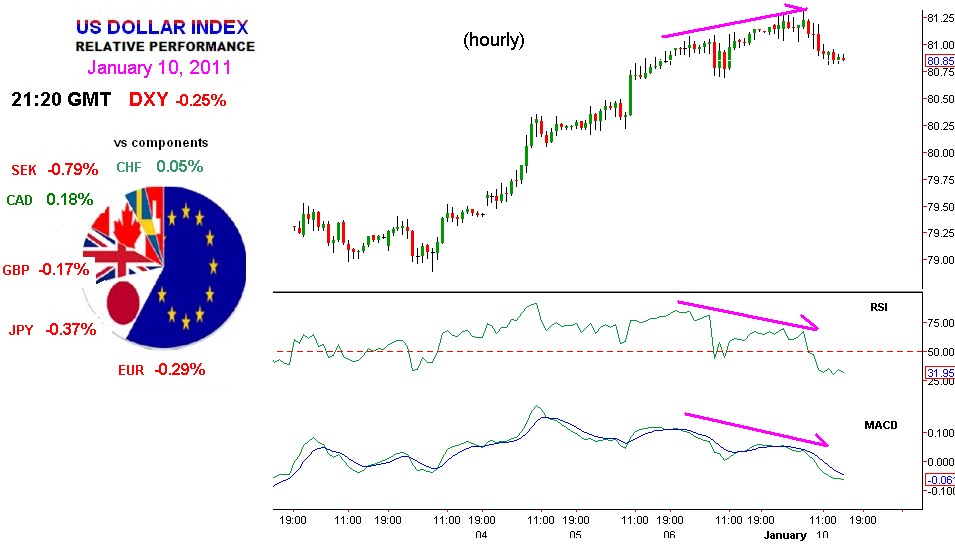
The US Dollar Index (DXY) consolidated the latest 4-day rise, retreating on the back of bearish diverging hourly studies. The immediate uptrend, however, remains intact while prive-action remains supported by the 80.820 previous resistance pivot on a (daily) closing basis. In the event that 80.820 is breached to the downside, oversold dips that exhibit bullish intraday divergence should be accumulated between the 80.344/80.679 region, the 38.2% & 25% retracement of the latest advance. The counter-trend reversal should last no longer than a few days, thus if the 81.444 peak is not within reach by Thursday, then the current correction could persist through next week.

The EUR/USD formed a small-intraday base, allowing consolidation of the latest steep drop to take hold. Bullish diverging hourly studies triggered a corrective rally that probed the former swing low at 1.2970. The bearish structure is firmly intact while price-action remains capped by this former pivot on a closing basis. In the event that 1.2970 is broken cleanly to the upside, a move could emerge into the 1.3013/1.3087 region (25% & 38.2% retracements of the latest decline). Short positions should be initiated if accommodated by bearish diverging hourly studies. Meanwhile, the Euro Index (EXY) failed to reach the targeted 102.78/103.18 region, which suggests the completion of a five-wave decline. The single currency, however, remains bearish while below the previous swing at the 105 figure.